 Chirp Suite
Not every bad review is a fake one. Most are real customers who had a worse time than you meant them to have.
A few are mistaken, a few are malicious, and fewer still are fake. They need different handling, and the wrong one can make things worse.
Three kinds of bad review
A bad review is harsh but real, mistaken, or fake, and each needs a different response.
Harsh but real
The customer was there, and their view is unfair or exaggerated. You cannot remove it, because being unfair is not a policy violation.
Answer it calmly. Readers can usually tell when a reviewer is being unreasonable, and a polite reply makes that clearer.
Mistaken
The review is about another business, another branch or something you do not do. Say so politely and invite them to check. If it is clearly about a different business, you can report it as off-topic.
Fake or abusive
There is no record of the customer, the review comes from a competitor or an ex-employee, it contains threats, hate or private information, or several reviews arrive together with similar wording. These may break the site's policies and can be reported.
Have a reply drafted already? Try the draft check alongside this guide. It is free, with no sign-up.
Start with the records
Check your own records first, before you reply or report anything.
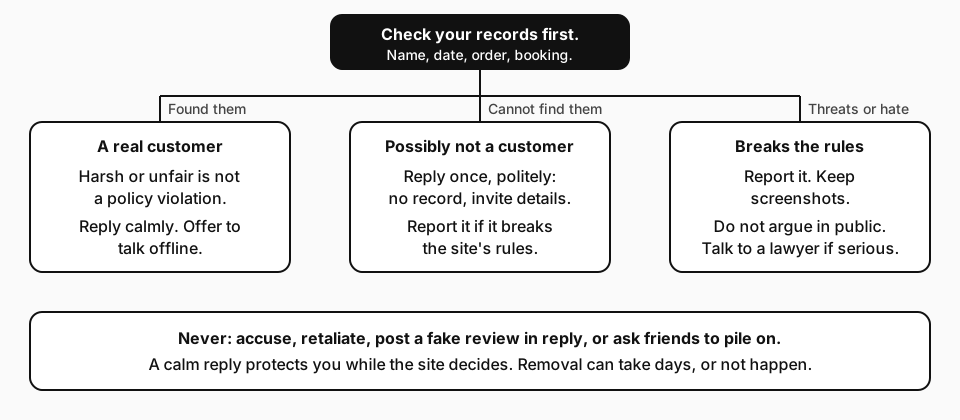
Before you decide a review is fake, look for the name, the date, the order or the booking. Ask staff. A surprising number of "fake" reviews turn out to be a real customer using a different name or a partner's account.
Signs a review may be fake
These signs suggest a review may not come from a real customer, but none is proof on its own.
- You cannot find the person, the date or the order.
- The reviewer has posted only one review, or many one-star reviews of competitors.
- It describes services you do not offer.
- A cluster of similar reviews arrives in a short time.
- The language is generic, or the same phrases appear in other reviews.
These are clues, not proof. Do not accuse anyone in public.
What Google will and will not remove
Google's policy covers many kinds of content it removes, including fake engagement, rating manipulation, advertising and solicitation, repetitive content, off-topic content, misrepresentation, impersonation, and harassment and offensive content. It also says merchants may not discourage negative reviews or selectively solicit positive ones. It also treats content based on a conflict of interest as a violation. A review that follows the policies is not eligible for removal, however much it stings.
How to report a review on Google
You report a review from the review itself, and these steps show how.
For what happens after you report, see can you delete a Google review.
- Open your Business Profile reviews.
- Next to the review, select Report.
- Choose the reason that fits and send the report.
- Watch the status. You may see "Decision pending", "Report reviewed - no policy violation" or "Escalated".
Google says review evaluation typically takes several days. If the answer is no, Google offers a single appeal covering up to ten reviews, so gather your evidence before you use it. For content you believe is unlawful, such as a defamatory statement, Google has a separate legal removal form, and it says to flag the review in the product first.
A reply that works
Reply politely, state the facts and invite the reviewer to contact you.
"Thank you for the feedback. We have looked for a record of this visit and cannot find one, so I wonder whether the review was meant for another business. If you were a customer, please contact me at [email] with the date and any details, and I will look into it. [First name]"
It is polite, it states a fact and it leaves the door open. It does not call anyone a liar.
What not to do
Do not argue, threaten or retaliate. The lists below show what to do instead.
Do
- Save screenshots of the review and the reviewer's profile.
- Report each review against the specific policy it breaks.
- Reply once, calmly.
- Keep collecting real reviews.
Do not
- Post a fake review in return, or ask friends to counter it.
- Threaten the reviewer with legal action you do not intend to take.
- Offer money or a discount in return for removal.
- Reveal the customer's order, appointment or health details.
The law is on both sides of this. The US FTC's rule on reviews and testimonials, in force since 21 October 2024, bans writing or selling fake reviews and also bans using unfounded or groundless legal threats, intimidation or knowingly false accusations to suppress a review. In Canada the Competition Bureau has said that anyone who writes or permits reviews that give a false or misleading impression could be liable. If a review is seriously damaging, take advice from a lawyer before you act. This guide is general information, not legal advice.
Do not let it change how you ask
The best defence against one unfair review is a steady flow of real ones. See how to ask customers for reviews within the rules, and use the response templates when the next one arrives. For the full method on a review that is real but harsh, read how to respond to a negative review.