 Chirp Suite
The reply to a bad review is not really written for the angry customer. It is written for everyone who reads it afterwards.
In the 2026 BrightLocal survey of 1,002 US adults, 97% said they read reviews for local businesses and 89% said they expect owners to respond. Your answer is part of your sales page, and you are writing it on your worst day.
This guide gives you a method that holds up under stress, with examples for a restaurant, a tradesperson and a shop.
Why your reply matters
Google puts it simply in its help for business owners: when you reply to reviews, "you show them that you value their feedback." A calm, specific reply tells a reader how you handle a problem, which is the thing they cannot learn from a five-star review.
There is some research behind it too. A study of hotels by Davide Proserpio and Giorgos Zervas found that hotels that began responding to reviews on TripAdvisor saw their average rating rise slightly. The study covers hotels only, so read it as encouraging rather than proven for a bakery or a plumber.
Have a review in front of you right now? Try the reply helper alongside this guide. It is free, with no sign-up.
The five steps
Reply in five steps: pause, thank, say what you understand, commit to one real action and move offline.
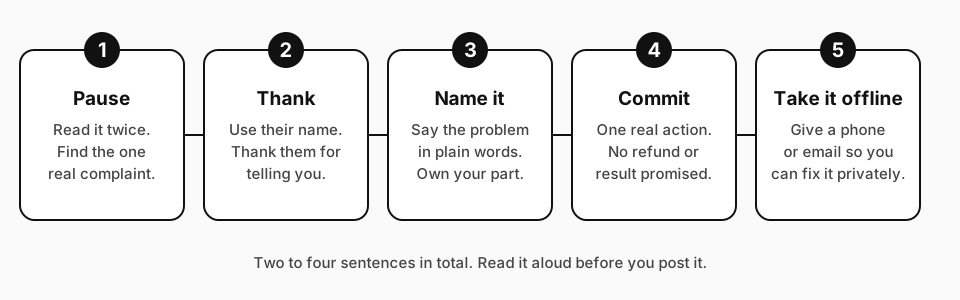
1. Pause, then read it twice
Read it once to feel the sting. Read it again to find what actually happened.
Do not write anything until you can name the one fact the customer is upset about. If you cannot, ask them in the reply instead of guessing.
2. Thank them and use their name
Start with thanks for taking the time to tell you. This is not weakness. It tells every reader that you listen.
3. Say what you understand, without arguing
Repeat the problem in plain words: "You waited 40 minutes with a booking." If part of it is your fault, say so in one sentence. If it is not, do not argue the point in public. Both are easier to read than a long explanation.
4. Commit to one real action, only if you will do it
Name one thing: you are changing the booking process, you are checking with the team, you would like to make it right. Do not promise a refund, a discount or a result you may not deliver.
5. Move the conversation offline
Give a direct way to reach you, such as a phone number or an email and your first name. This keeps the details of the dispute out of public view and shows you are serious about fixing it.
Three worked examples
These three examples show the five steps for a restaurant, a tradesperson and a shop.
A restaurant: the long wait
Review: "We waited 40 minutes for a table even though we booked. Nobody even said sorry."
Reply: "Thank you for telling us, and I am sorry about the wait. A booking should mean a table, and we got that wrong on Saturday. We are changing how we hold tables during the dinner rush. If you would like to talk it over, please call me on [phone]. I would like the chance to do better. [First name], owner"
Why it works: it names the problem, owns it, commits to one change and moves offline. It does not mention compensation.
A tradesperson: the late arrival
Review: "Showed up two hours late and did not call."
Reply: "Thanks for the honest feedback. You should have had a call when we were running behind, and you did not get one. That is on us. I have reminded the crew to phone ahead whenever a job runs over. Please email me at [email] if you want to talk about the job itself. [First name]"
A shop: a review that is partly unfair
Review: "Overpriced and the staff were rude. Never again."
Reply: "Thank you for the feedback. I am sorry your visit was not a good one. I would like to understand what happened with our team, so please contact me at [email]. Our prices reflect [one fact, such as local materials or repair warranties]. [First name]"
Why it works: it does not argue the "rude" claim, it asks for details, and it gives one factual reason for price instead of a defence.
What to say and what to leave out
Say what happened and what you will do. Leave out blame, excuses and promises of money.
Do
- Reply within a day or two.
- Use their name and one detail from the review.
- Own the part that is your fault.
- Offer a way to talk privately.
- Sign with a real first name.
Do not
- Say "you are wrong", even when they are.
- Share order details, health information or anything that identifies their visit.
- Be sarcastic or blame the customer.
- Promise a refund or free service in public.
- Paste the same reply into every review.
If you run a clinic, a law practice or another regulated service: be careful about even confirming that the reviewer was your client or patient. A public reply that says "we saw you on Tuesday" discloses something about them. Your professional body may have specific rules. Keep the reply generic ("we take every concern seriously, please contact us") and take the detail offline.
What to do after you post
These are the steps to take once your reply is live.
- Follow up privately if they respond, and do what you said.
- Record the complaint. If three people mention the same thing, it is a pattern. Review insights can pull the themes out of a batch of reviews for you.
- Ask for more reviews. One bad review matters less when there are many good ones. See how to ask customers for reviews.
- Reuse what worked. Keep your best replies as a starting point. The review response templates give you eight to begin with.
If you believe the review is unfair or fake, read what to do about an unfair or fake review before you reply. If you want to check your wording first, the draft check flags promises, private details and tone.